Dr. Sonja Kristiansen explains fertility preservation at Houston Fertility Center.
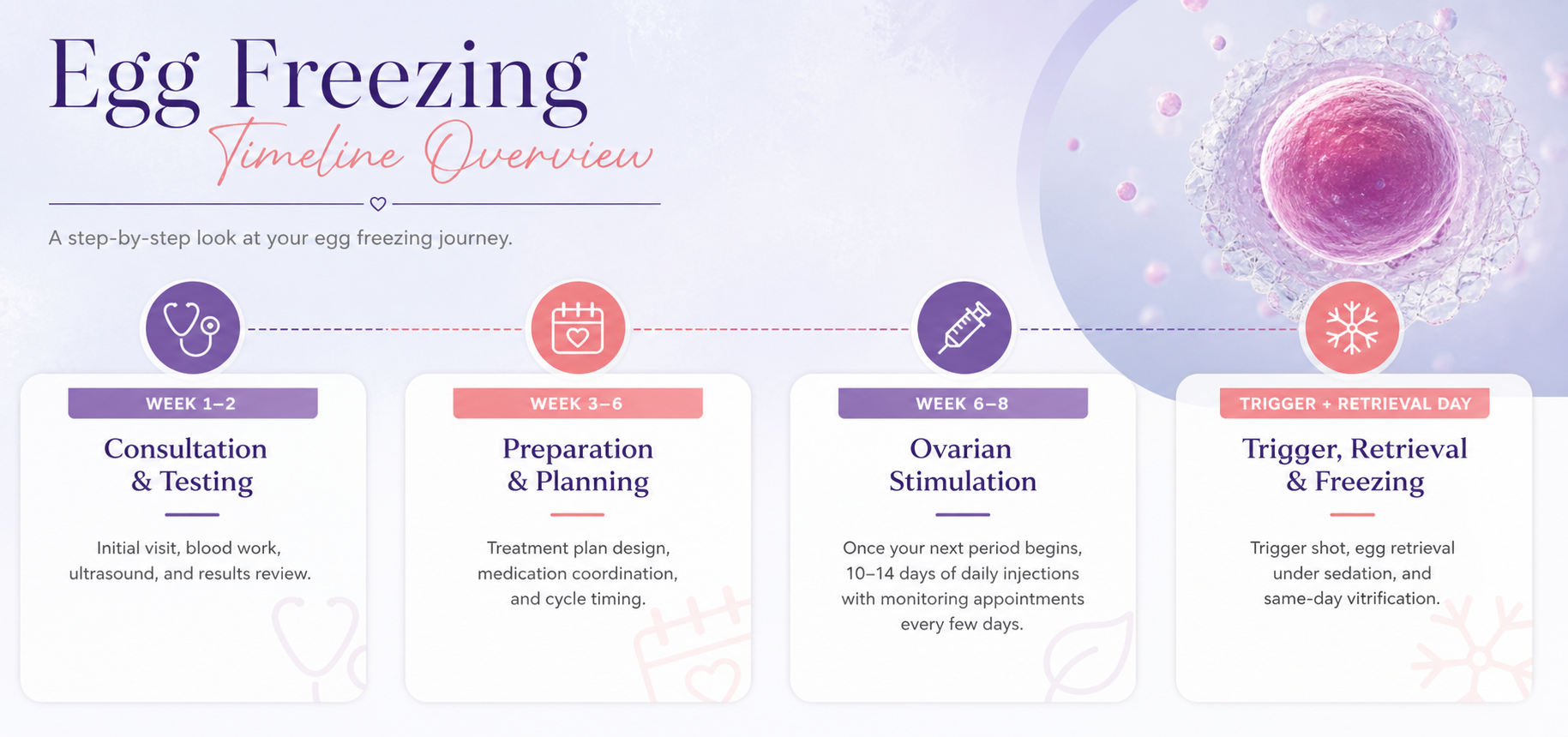
One of the most common questions we hear from patients considering egg freezing is how long the process actually takes. The short answer: the active treatment cycle runs approximately two weeks. But the full timeline, from your first consultation through retrieval and storage, typically spans six to eight weeks.
Here is a detailed breakdown of each phase, how long it takes, and what to expect at every stage of the egg freezing process at Houston Fertility Center.
At a Glance
The Details
The egg freezing timeline begins with a consultation at our Houston office. During this visit, we review your medical history, discuss your goals, and order baseline testing to evaluate your ovarian reserve:
Results are typically available within a few days. We then schedule a follow-up to review findings and build your treatment plan. This phase takes approximately one to two weeks.
Once your results are in, we design a stimulation protocol specific to your ovarian reserve and health profile. This phase also involves coordinating your medication order and timing your cycle start date. Depending on scheduling and your menstrual cycle, this preparation window is typically two to four weeks.
Stimulation begins on day 2 or 3 of your next menstrual cycle, which is why the prep window in weeks 3–6 depends partly on when your period arrives. This is the most active phase of the egg freezing timeline. You will self-administer injectable medications daily for 10 to 14 days to stimulate the ovaries to produce multiple eggs in a single cycle.
During stimulation, you'll visit our clinic every two to three days for monitoring. Each appointment includes blood work and an ultrasound to track follicle growth, and we adjust medication dosages based on your response. Most patients have four to six monitoring visits total during this phase.
Our woman-led care team provides hands-on guidance with injections at your first appointment and remains available throughout the cycle for any questions.
When follicles reach the target size, we schedule a precisely timed injection known as the trigger shot. This signals the eggs to complete their final maturation. The timing is critical. Retrieval is performed exactly 36 hours later to collect eggs before ovulation occurs naturally.
Egg retrieval is a brief outpatient procedure performed under light sedation in our on-site laboratory. Using ultrasound guidance, eggs are collected from each mature follicle through a thin needle. The procedure itself typically takes 15 to 20 minutes.
Plan to have someone drive you home afterward. Most patients return to normal activities within one to two days. Mild bloating or cramping is common and resolves quickly.
Immediately following retrieval, our embryology team evaluates the collected eggs in our on-site lab. Mature eggs undergo vitrification, a rapid-freezing technique that prevents ice crystal formation and preserves cellular integrity.
“Because our laboratory is in the same facility as our procedure rooms, eggs go directly from the procedure room to the embryologist within minutes with no transport delay.”
Your eggs are stored securely in the lab according to your consent and storage agreement.
Timing Your Decision
While the treatment cycle itself takes only a few weeks, the decision of when to begin matters significantly. Age is one of the most important factors in egg freezing outcomes, because egg quality and quantity decline naturally over time, with fertility declining gradually in the early 30s and more rapidly after about age 37.
A baseline assessment of your ovarian reserve through blood work and an ultrasound gives us concrete data to guide your decision, regardless of age. The consultation itself takes less than an hour.
A baseline ovarian reserve assessment takes less than an hour and gives you concrete data to guide your decision.
Planning for Success
The number of eggs you may want to freeze affects how many cycles appear on your egg freezing timeline. Estimates from peer-reviewed predictive models (including the widely cited Goldman et al. age-stratified model used by many U.S. fertility clinics) suggest the following targets for a reasonable probability of one live birth:
We review results after each cycle and recommend whether additional retrievals would meaningfully improve your chances.
Egg freezing can improve future reproductive options, but it cannot guarantee a future pregnancy or live birth. Outcomes depend on a number of individual factors, which we discuss in detail during your consultation.
When the Time Comes
When you are ready to pursue pregnancy, your frozen eggs are thawed and fertilized using intracytoplasmic sperm injection (ICSI). At our practice, the resulting embryos are cultured in our laboratory and undergo preimplantation genetic testing (PGT), which is included with IVF and INVOcell® treatments at Houston Fertility Center, not offered as a separate add-on.
Because PGT requires embryos to be cryopreserved while results are pending, embryo transfer is typically performed as a frozen embryo transfer at our practice. Research suggests that frozen embryo transfer can offer advantages in certain cases, including more flexible cycle timing and the ability to optimize the uterine environment before transfer.
Our Practice
Several features of our practice directly benefit patients pursuing fertility preservation:
A consultation is the first step. We can evaluate your ovarian reserve and help you determine whether egg freezing aligns with your goals and timeline.
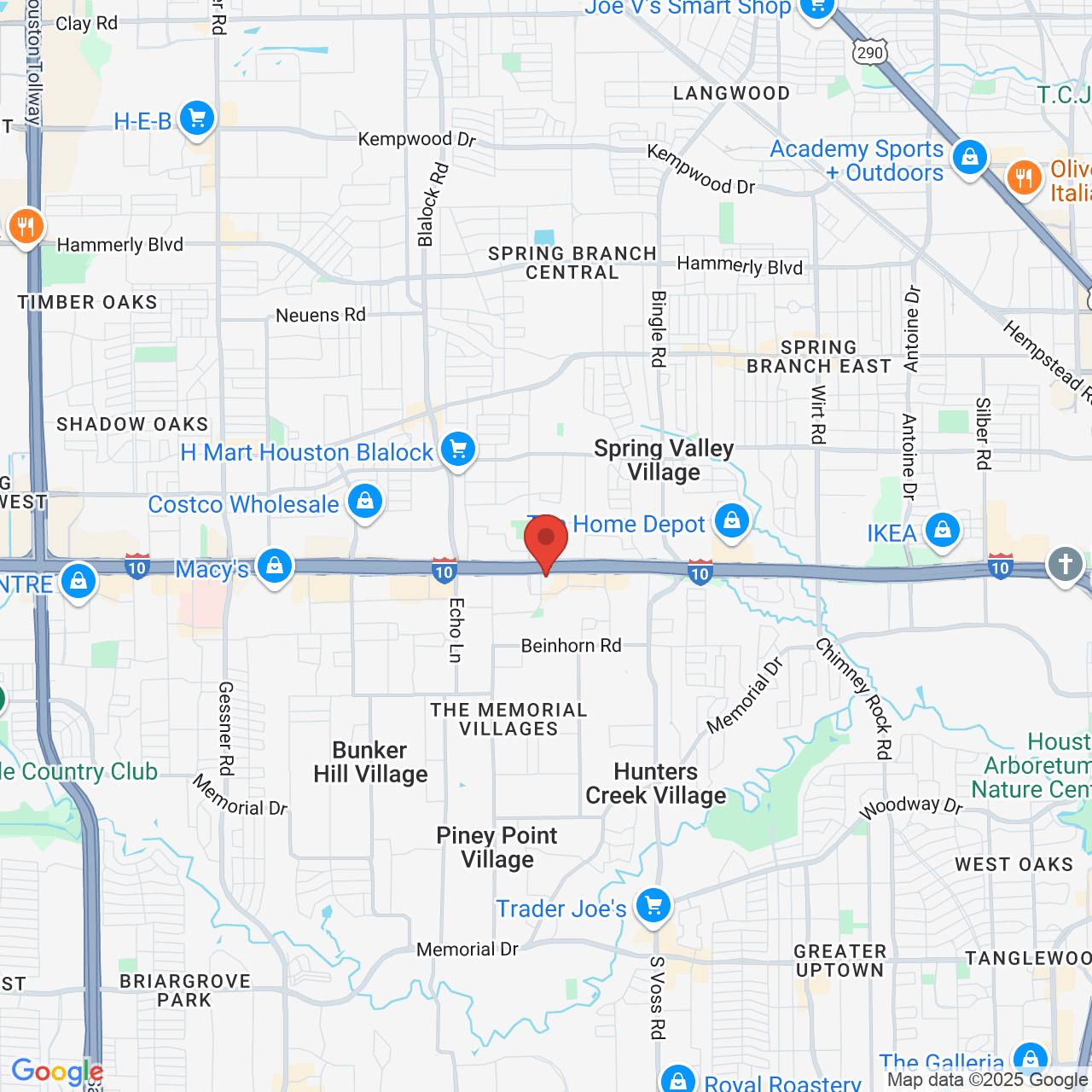
Houston Fertility Center • 9055 Katy Fwy, Ste 450, Houston, TX 77024
Serving Houston, Cypress-Fairbanks, and surrounding areas.
Led by board-certified Reproductive Endocrinologist Dr. Sonja Kristiansen, Houston Fertility Center. As a proudly independent practice, we offer transparent pricing: $10,100 for INVOcell with PGT and $14,100 for IVF with PGT.
Our facility welcomes both local and out-of-town patients and is affiliated with leading medical organizations, including:
Whether you're just beginning your fertility journey or exploring advanced treatment options, we're here to support you. Call (713) 862-6181 or contact us online to schedule your consultation.